Category: Kids play rooms

  • How to Choose the Right Chair and Table Height for Kids

    What chair and table height should you choose for your child?

    A very common question we get asked is: What chair and table height should we use for children?

    This is an important question because children’s furniture is not simply a smaller version of adult furniture. The correct dimensions depend on the child’s age, size, and how the furniture will be used.

    One important thing to understand is that children under two years old may not be able to sit safely and independently on a standard children’s chair. For younger children, chairs may need additional support, such as a back or side guard, depending on the design and the child’s abilities.

    It Depends on What You’re Designing

    Choosing the right chair and table height depends heavily on what you are designing the furniture for.

    For example, if you are designing furniture for a school or nursery, the dimensions should follow the appropriate age-group requirements and standards. The chair and table need to work together ergonomically so that children can sit comfortably and use the furniture properly.

    For a home playroom, however, you have more flexibility.

    This is where one of the most important questions comes in:

    How long do you want your child to use the furniture?

    Designing for One Age vs. Several Years

    I’ve seen many parents ask for furniture designed for an older age group because they want their children to be able to use it for several years.

    For example, imagine you have a three-year-old child and you are designing a playroom that you want them to use for the next four years.

    You could choose furniture that is slightly larger and more appropriate for a six-year-old, allowing the child to grow into it and potentially use the furniture for several years.

    However, there is a trade-off.

    Furniture designed for an older child may not be as comfortable or functional for a three-year-old today.

    On the other hand, if you know that the furniture will only be used for one year, it makes more sense to design it specifically around the child’s current age and size.

    Think About the Entire Period of Use

    When choosing children’s chairs and tables, don’t only ask:

    “What size is my child today?”

    Also ask:

    “Who will use this furniture, and for how many years?”

    This can completely change the dimensions you choose.

    A playroom designed for a three-year-old that will remain unchanged until they are seven should be approached differently from a playroom that is being designed specifically for a three-year-old for the next 12 months.

    The goal is to find the right balance between comfort, ergonomics, safety, and longevity.

    Whenever you are designing children’s chairs and tables, always consider the child’s age, their size, how they will use the furniture, and how long you expect them to use it.

    The “right” children’s furniture isn’t necessarily the smallest furniture available. It’s the furniture that is appropriate for the child and the way the space will actually be used.
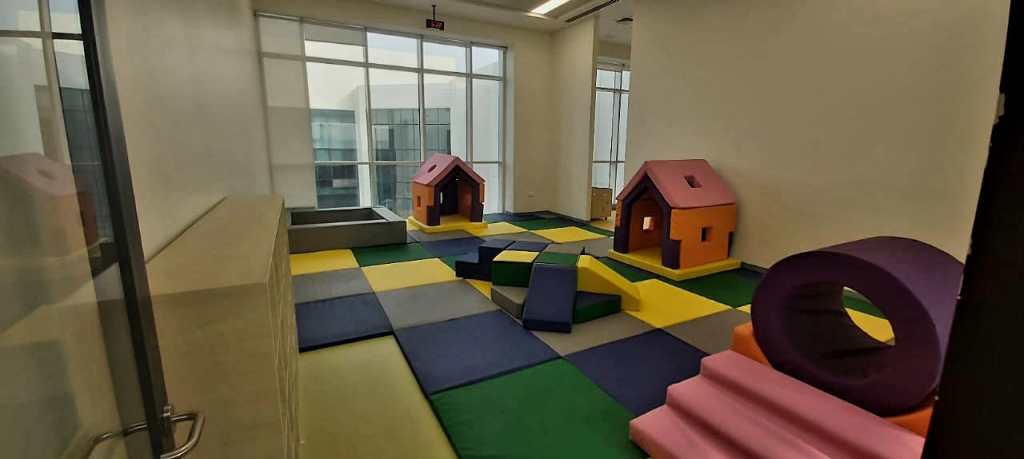
  • How to Choose the Right Flooring for a Kids’ Playroom

    From soft play mats to crash mats, here’s what I recommend based on children’s age and the activities in the room.

    Designing a playroom is never easy. There are so many things to think about: the furniture, toys, colors, climbing equipment, storage, and overall design.

    However, one of the most important elements is often overlooked: the flooring.

    Flooring may not provide a direct play function, but from a safety perspective, it can be one of the most important decisions you make when designing a kids’ playroom.

    Why Is Playroom Flooring So Important?

    Children run, jump, climb, and fall. Even when a playroom is carefully designed, accidents can happen.

    The right flooring can help reduce the impact of a fall and provide a safer surface for children to play on.

    There are many flooring options available, including:

    • Rugs
    • Carpets
    • Foam or jigsaw mats
    • Safety mats
    • Crash mats
    • Padded flooring

    But the best option depends largely on the age of the children and the activities taking place in the room.

    Best Flooring for Children Under 5

    For children under five years old, I generally recommend using soft, padded flooring throughout the main play area.

    Good options include:

    • Jigsaw foam mats
    • EVA foam flooring
    • Thin safety mats
    • Other purpose-designed padded play surfaces

    Young children are still developing their balance and coordination, so falls are common. Having a softer surface underneath them can help reduce the impact when they fall.

    What About Rugs and Carpets?

    Rugs and carpets are comfortable and can make a playroom look beautiful. However, they should not automatically be considered safety flooring.

    Most standard rugs and carpets are relatively thin and provide very little impact absorption against a significant fall.

    For example, if a child falls from a climbing structure, a normal carpet may provide some cushioning, but it is not designed to absorb the impact of a fall from height.

    That is why, when safety is the priority, I prefer properly designed foam or safety mats rather than relying only on a decorative rug or carpet.

    What About Children Over 5?

    For children over five, the flooring choice can become more flexible.

    If the playroom doesn’t contain climbing equipment or activities where children could fall from height, a good-quality carpet or rug can be perfectly reasonable, depending on the overall design.

    However, if the room contains a climbing wall, climbing frame, monkey bars, or another activity where a child could fall, I recommend using a crash mat or appropriate impact-absorbing surface directly underneath the fall zone.

    The key is to match the flooring to the risk of the activity, rather than simply choosing flooring based on appearance.

    My Simple Rule for Playroom Flooring

    When designing a playroom, I like to think about flooring in three categories:

    Under 5 years old:
    Choose soft, padded flooring for the main play area.

    Over 5 with no significant fall risks:
    Carpet or a suitable rug can be a good option.

    Any age with climbing or fall hazards:
    Use an appropriate crash mat or impact-absorbing safety surface underneath the equipment.

    A beautiful playroom is great, but a well-designed playroom should also be safe, age-appropriate, and designed around how children actually play.

    After working on hundreds of playrooms and children’s spaces, I’ve learned that flooring is one of those elements that shouldn’t be treated as an afterthought. It may not be the most exciting part of the design, but it can make a significant difference to the safety of the space.

  • How to Choose Age-Appropriate Play Equipment for Your Child

    Understanding how children play, learn, and develop at different ages can help you choose equipment that grows with them

    Children don’t all play, explore, or learn in the same way. Their age and stage of development have a big influence on the way they interact with their environment, which is why the right play equipment for a two-year-old can be very different from what works for an eight-year-old.

    When choosing equipment for your children, I always recommend starting with one simple question:

    How old are the children who will be using it?

    0–3 Years: Exploring Through the Senses

    During the first few years, children are discovering the world around them. They learn largely through exploration and sensory experiences.

    They touch, feel, smell, move, and manipulate objects as they begin to understand their environment.

    For this age group, I generally recommend equipment and activities that allow children to explore safely at their own pace.

    Some examples include:

    • Soft play floors
    • Soft play mats
    • Sensory boards and panels
    • Pikler structures
    • Simple climbing and exploration equipment

    At this stage, the goal isn’t necessarily to give children the biggest or most challenging piece of equipment. It’s about giving them opportunities to explore and develop through their senses and movement.

    4–7 Years: Imagination, Creativity and Movement

    As children get older, the way they interact with their environment starts to change. They begin to use their imagination and creativity much more in their play.

    This is why role play becomes particularly important.

    A playhouse can become a shop, a kitchen, a school, or almost anything a child can imagine. At the same time, children are becoming more confident physically and can begin to engage with more challenging movement-based activities.

    For this age group, I would consider:

    • Role-play houses
    • Climbing frames
    • Small climbing structures
    • Monkey bars
    • Climbing walls
    • Other age-appropriate physical activities

    The combination of imaginative play and physical play can make a play space much more engaging at this stage.

    7–12 Years: Challenge, Physical Play and Interaction

    By this age, children generally have greater physical capabilities and can engage with more challenging equipment.

    They may start looking for activities that test their strength, coordination, balance, and physical skills. They also become increasingly interested in playing and interacting with other children.

    For this age group, I would look at:

    • Larger climbing frames
    • Outdoor climbing structures
    • More physically challenging equipment
    • Advanced climbing activities
    • Interactive games and activities

    At this stage, the play space can become less about simple exploration and more about challenge, physical development, and social interaction.

    Choosing Equipment Isn’t Just About Age

    Age is one of the first things I look at when deciding what equipment is appropriate, but it isn’t the only factor.

    Children develop at different rates, and every child is different. The important thing is to understand what the child is capable of, what they enjoy, and what you want the space to achieve.

    The goal isn’t simply to fill a room with equipment.

    The goal is to choose the right equipment for the child who will actually use it.

  • Before You Design a Playroom, Ask Yourself These 4 Questions

    A simple guide to creating a play space that grows with your child and actually fits your family’s needs.

    beautifull playroom design

    A lot of parents come to me asking how to design a play space for their children at home.

    They want to know what equipment to buy, where to get it, what age group they should design for, and whether they should make the room multifunctional or focus purely on play.

    My answer usually starts with a much simpler question:

    1. What are you actually using the room for?

    When parents decide they need a playroom, there is usually a reason behind it. The playroom should first solve that need.

    Is the room only for play?
    Do you want your children to learn there as well?
    Will they eat there?
    Will siblings share the space?
    Will it also be used for reading, drawing, or other activities?

    For example, if you’re trying to create a play and learning space, you need to think beyond play equipment. You might want a combination of play activities, a reading area, and a desk or table for learning and creative activities.

    So, the first question is: What is the purpose of the room?

    2. What is the age group?

    The second question I always ask is: Who is going to use the space?

    Designing a playroom for a two-year-old is completely different from designing one for a six-year-old.

    You also need to understand whether you’re designing the room for your child’s current age or for the future. Some parents create a playroom for a baby with the intention that the child will start using it more as they grow.

    Children also learn and interact with spaces differently at different ages. A two-year-old may benefit more from sensory experiences and simple exploration, while a five-year-old may be more interested in role play, climbing, and more challenging physical activities.

    Understanding the age group is therefore essential before deciding what equipment and activities belong in the room.

    3. What is your budget?

    The third question is an important one: How much are you comfortable investing?

    A playroom is an investment in your children’s environment, but it doesn’t have to be ridiculously expensive.

    You can create a great playroom on a relatively low budget by making thoughtful choices about what you include. At the same time, if you have a larger budget, there are many opportunities to create a highly customized and elaborate playroom.

    The important thing is to be honest with yourself about what you can afford and design the room around that budget.

    4. How long will your children use it?

    Finally, ask yourself: How long do I expect my children to use this room?

    Will they use it for one year? Two years? Five years? Ten years?

    This is important because children’s interests change as they grow. The equipment and activities that excite a two-year-old might not interest them a few years later.

    If you’re investing significantly in the space, think about whether you want to design specifically for your child’s current age or create something that can evolve with them.

    The four questions

    Before you start buying equipment, choosing colors, or designing the room, ask yourself:

    1. What is the purpose of the room?
    2. What age group will use it?
    3. What is my budget?
    4. How long do I want my children to use it?

    Once you have answers to these four questions, designing the playroom becomes much easier.

    You can then start thinking about the equipment, layout, activities, furniture, and materials that actually make sense for your family.